| |
Jun 07, 2026
|
|
|
|
|
DRAFT 2026-2027 Graduate Catalog
Chemistry (M.S.)
|
|
 Return to: Programs and Degrees (Listed Alphabetically by Program) Return to: Programs and Degrees (Listed Alphabetically by Program)
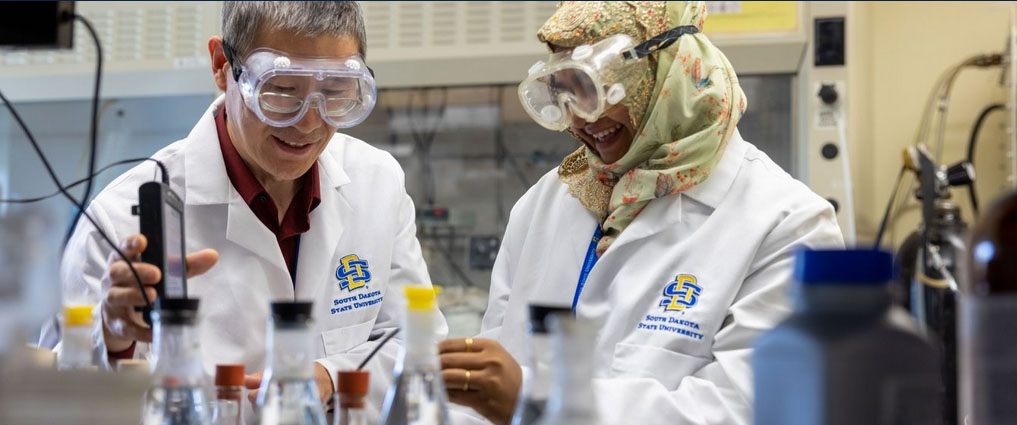.png)
Program Coordinator/Contact
Cheng Zhang, Associate Professor
Department of Chemistry, Biochemistry and Physics
Avera Health and Science Center 247, Box 2202
605-688-5151 or 605-688-5428
Program Information
The department’s chemistry faculty research programs fall into the thematic focus areas of environmental chemistry and green chemistry, chemical sensor development, organic synthesis, materials chemistry, natural products chemistry, and chemical education. Within these multidisciplinary and interdisciplinary focus areas, students can select research projects that involve the traditional subdisciplines of chemistry – analytical, biochemistry, inorganic, organic and physical. Currently active research projects in the Department focus on various aspects of analytical chemistry, drug discovery and delivery, synthesis or photoactive materials including polymers, materials chemistry and self-assembly, chromatography, the chemistry of cell membranes, cancer biology, environmental and green chemistry, chemistry of climate change, photo-physical chemistry, natural products synthesis, biophysical chemistry, computational chemistry, and solid-state NMR. For additional information about these options review the descriptions of current faculty research interests on the department website.
In addition to a traditional thesis-based M.S. degree, the department also offers a predominantly online Chemistry M.S. with chemistry education specialization. This is a non-thesis degree that focuses on the content necessary for practicing high school teachers to achieve highly qualified status. Admission in this program is limited to practicing high school science teachers. Students interested in thesis-based M.S. degree in the sub-disciplinary area of chemistry education should select the Chemistry (M.S.) program in their application for admission.
|
Research Infrastructure
The Department of Chemistry, Biochemistry, and Physics at South Dakota State University boasts state-of-the-art research infrastructure housed within the Avera Health and Science Center’s laboratory and research wing. The department features specialized core facilities to support its innovative research programs, including the Core Mass Spectrometry Facility and the Core Nuclear Magnetic Resonance (NMR) Facility. These cutting-edge facilities are readily available to graduate students, faculty, and even industry partners, providing invaluable hands-on experience and driving forward research in fields ranging from advanced materials to cancer biology. In addition to these core facilities, a wide array of specialized instrumentation is maintained within individual faculty laboratories, ensuring the department possesses ample modern resources to conduct transformative, real-world research. Available Options for Graduate Degrees
Master of Science Total Required Credits: 30 (Thesis)
Additional Admission Requirements
GRE: General and subject score are recommended but not required
TOEFL iBT: 4
TOEFL Essentials: 7.5
IELTS: 6.0
Duolingo: 100 The priority deadline for applying for admission for the fall semester is December 1. A secondary deadline is January 15. The department typically does not admit students for the spring semester unless applicants have secured funding for their graduate education. Support can come from three sources: - Research assistantship from a professor in the department
- Personal or family funds
- Scholarship from the government or an organization
In addition to the materials required by the Graduate School, the Department of Chemistry, Biochemistry and Physics requires the following application materials: - A one- to two-page personal statement which includes a description of undergraduate research, work experience, or other factors demonstrating a propensity toward graduate studies. The personal statement should also include a statement of the applicant’s career goals. The applicant may upload this statement while completing the Graduate School’s online application.
- Two letters of recommendation, preferably at least one from faculty at the applicant’s undergraduate institution. Letters should come from faculty who are directly familiar with the applicant’s academic work. They must address the applicant’s scholarly potential and may also speak to the applicant’s potential for graduate studies in the discipline. Letters should come directly from the recommenders, who may submit their letters electronically along with the personal recommendation form provided by the Graduate School. The Graduate School will email recommenders detailed instructions for submitting their recommendations using the contact information provided by the applicant.
General Requirements
Graduate students should consult with their advisor before registering for graduate coursework. For additional information, refer to the Master’s Degree Requirements . |
Return to: Programs and Degrees (Listed Alphabetically by Program)
|
|