Jun 04, 2026  
DRAFT 2026-2027 Undergraduate Catalog 
    
DRAFT 2026-2027 Undergraduate Catalog

Electrical Engineering (B.S.) - Power Systems Engineering Specialization

Location(s): Brookings Main Campus


Return to {$returnto_text} Return to: Academic Programs - Majors, Minors, Certificates

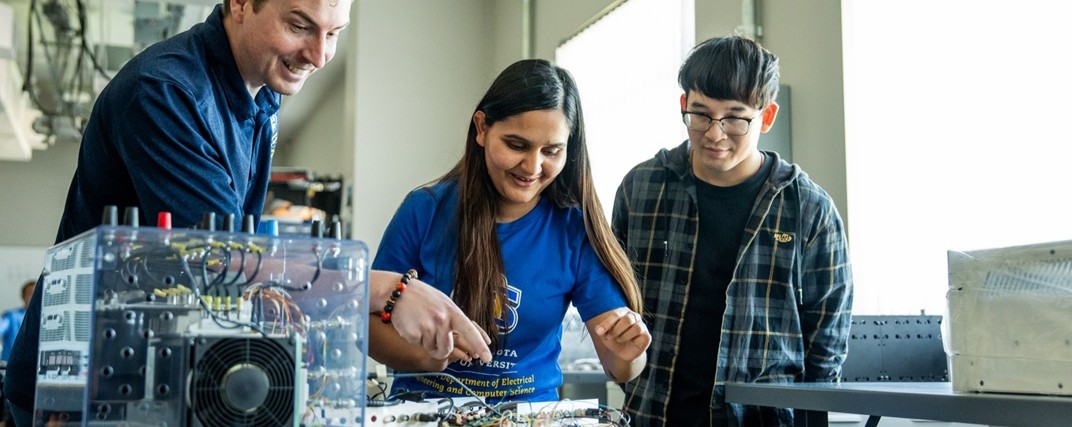
An instructor working with students in an electrical engineering lab.

Apply Now Request More Information

Program Coordinator/Contact

Sungyong Jung, Department Head
McComish Department of Electrical Engineering and Computer Science
Daktronics Engineering Hall 214
605-688-4526

Program Information

Electrical engineers address complex technical challenges across fields such as biomedical engineering, communications, computing and digital hardware, electronic materials and sensors, image processing, control systems, and alternative energy and power systems. Power and energy technologies support every aspect of modern life—from manufacturing and raw material processing to the Internet and emerging areas like quantum information processing—making reliable and resilient infrastructure essential.

The Power Systems Engineering specialization provides a strong foundation in the theory, analysis, and operation of electric power systems. Through focused coursework, students gain an understanding of power system fundamentals, control principles, and core analytical methods, along with exposure to smart‑grid technologies, including computer‑based analysis, monitoring, and communication systems.

Graduates are prepared for careers in the power and energy industry—such as Power Systems Engineer, Substation Engineer, Protection and Control Engineer, Grid Operations Engineer, Grid Interconnection Engineer, Renewable Electrical Design Engineer, Product Development Engineer, Field Service Engineer, Plant Electrical Engineer, Reliability Standards Engineer, and Energy Policy Implementation Engineer—or to continue advanced study in power systems and related fields.

Accreditation

The Electrical Engineering (BS) program is accredited by the Engineering Accreditation Commission of ABET, under the General Criteria and Program Criteria for Electrical, Computer, Communications, Telecommunication(s) and Similarly Named Engineering Programs.

Certification and Licensure

Upon successful completion of both the Electrical Engineering curriculum and the Fundamentals of Engineering (FE) exam, and five years of engineering work experience under a professional engineer (PE), the student is allowed to take the PE exam to become a licensed PE.  

Academic Requirements


The following requirements must be met to earn a Bachelor of Science Degree in Electrical Engineering:

  • Students must earn a “C” or better in EE 216 EE 216L EE 218 EE 218L EE 222 EE 222L EE 245 EE 245L , and EE 260 
  • Combined average of “C” or better in the Electrical Engineering courses.
  • Students are required to take the Fundamentals of Engineering examination prior to graduation.

Requirements for Electrical Engineering Major - Power Systems Engineering Specialization: 130 Credits


Bachelor of Science

Major Requirements


Total Required Credits: 130


Summary of Program Requirements


Bachelor of Science

  • System General Education Requirements*: 29 Credit Hours
  • Major Requirements: 101 Credit Hours
  • Electives**: 0 Credit Hours

*System General Education Requirements for students pursuing a baccalaureate degree shall include a minimum of 30 credit hours. Some general education coursework may be counted for Major Requirements and Supporting Coursework.
**Taken as needed to complete any additional degree requirements.

Academic Advising Guide Sheet


The goal of the academic advising guide sheets and sample plans of study is to promote undergraduate student success by guiding all students to timely completion of an undergraduate degree. Students are not limited to the course sequence provided for their academic program. Instead, the sample plan of study is one possible path to completing your degree and is meant to be used as a guide for planning purposes in consultation with an academic advisor. The plans also help students prepare for meetings with their academic advisor and track their progress in their selected academic program.

Return to {$returnto_text} Return to: Academic Programs - Majors, Minors, Certificates